
Blandford Forum Summed Up
By Paul Hyland, local poet and author.
In 1724 Daniel Defoe, author of Robinson Crusoe and A Journal of the Plague Year, described Blandford as “a flourishing borough and market town containing five hundred houses, many of them built of stone… No town hereabouts has so great a number of gentlemen’s seats round about it as this, invited hither perhaps by the pleasant downs adjoining which can hardly be equalled in the world.”
Blandford, he continued, “…was chiefly famous for making the finest bone lace in England, and where they showed me some so exquisitely fine, as I think I never saw better in Flanders, France or Italy, and which they said they rated at above 30l sterling [£30 or £7,000 today] a yard.” In the 18th and 19th centuries, button making became the town’s biggest industry, succeeded only by glove making. Inmates of East Street’s workhouse, opposite what is now Nightingale Court, were trained to make buttons. One of them, a young woman by the name of Caroline Watts, wrote poems to keep her spirit alive against the odds. Her book, Poems of a Blind Girl, was published in London in 1864.
Blandford is a famous survivor. After its heart had been consumed by fire in 1579 it had “risen up againe, fairer built than before.” In 1644, during the Civil War, the town was sacked and plundered by Major William Sydenham for its loyalty to the Crown. In 1677 another fire made thirty-three families homeless and in July 1713 a blaze destroyed the lower part of East Street. However, it was the Great Fire of 6th June 1731, which broke out in the middle of a smallpox epidemic, that changed the town for good. It really was ‘for good’ because at that time, Blandford was fortunate to be home to two builder-architect brothers, John and William Bastard, who were largely responsible for rebuilding it (1731-60), leaving the best, most complete small Georgian town in England for us to enjoy. This is reflected in a recent inscription in front of John Bastard’s town hall:
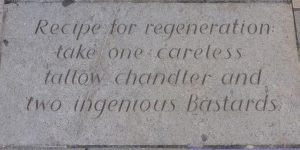
“Recipe for regeneration: take one careless tallow chandler and two ingenious Bastards”
The brothers built the new church, St Peter & St Paul, of greensand ashlar with Portland Stone columns and details. Frederick Treves, native of Dorset and surgeon to Queen Victoria (and the Elephant Man), judged the church “ugly, and only tolerable from a distance” while Nikolaus Pevsner calls it “a noble and eminently interesting building.”
A few significant incidents convey the flavour of Blandford’s history.
1731: the ducking stool (for scolds, unruly women) was burnt in the Great Fire.
1741: the last public execution in the town was carried out; William King and Ben Fluel were hanged in the market place for robbing Lady Grace Hayes.
1778: smugglers entered the town, firing pistols and breaking in to the house of the Supervisor of the Excise from which they liberated 16 cwt of tea and 9 casks of liquor.
1831: demonstrations and rioting over the Reform Bill; in October some houses were demolished and the windows of almost every opponent of reform in Blandford were broken; offices were ransacked and official papers and town records were thrown into the street.
1914: sub-lieutenant Rupert Brooke wrote, on Blandford Camp’s headed notepaper, one of the most famous poems of the First World War, ‘The Soldier’, which begins:
“If I should die, think only this of me:
That there’s some corner of a foreign field
That is forever England…”
1944: Captain Quentin Roosevelt, nephew of President Franklyn D. Roosevelt, was married in Blandford parish church to Frances Blanche Webb, a member of the US Red Cross who worked at ‘Doughnut Dugout’ in West Street, a home-from-home for US troops stationed in Blandford.